Picking the glasses
One AR-glasses decision for two ventures. The criteria that survived the cut, and why doing it once was the right move.
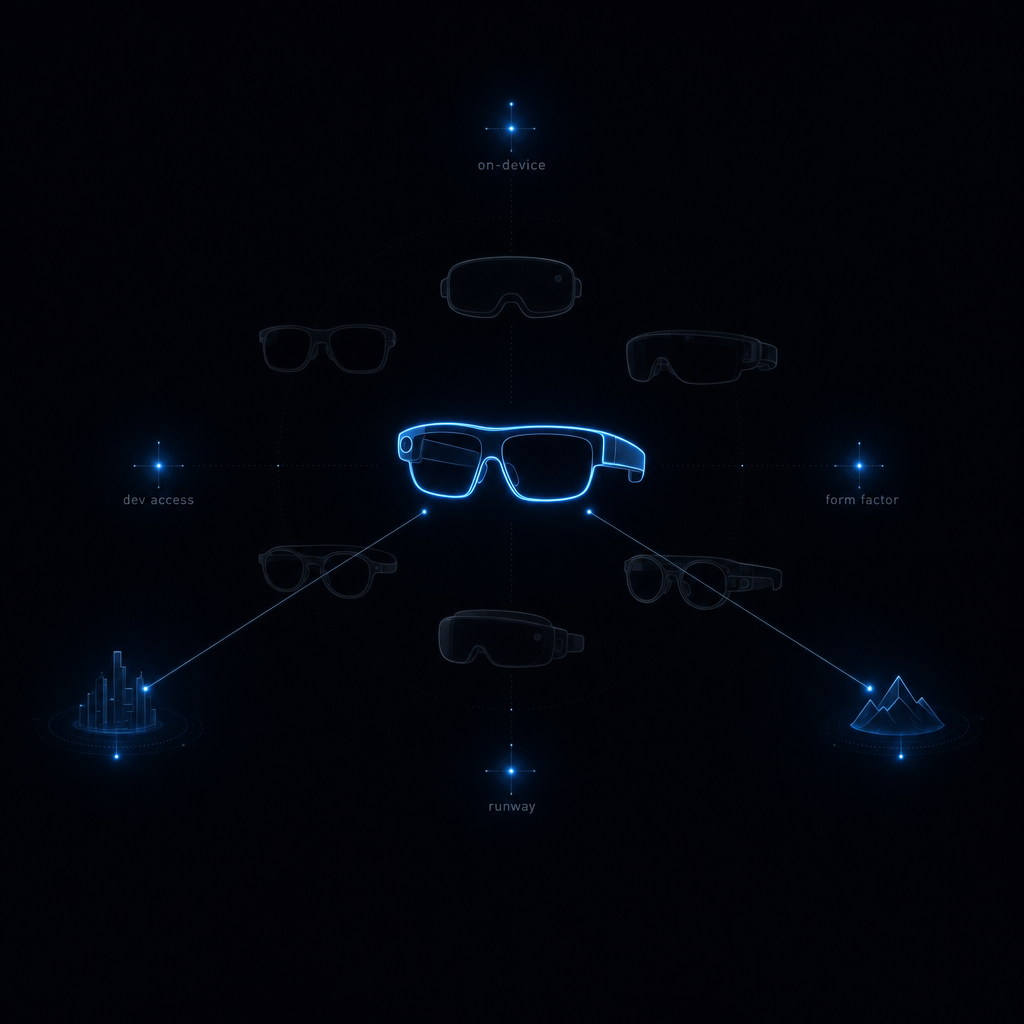
I picked AR glasses for two ventures in one decision. Here's how.
The decision sat on the list for a while. QC's roadmap has a Phase 2 that needs an AR overlay platform; Parley's roadmap has a Phase 6+ stretch goal that needs a wearable demo target. Either venture could have picked separately and probably would have, if I'd let the calendar push them apart. I didn't. I sat down on a Friday afternoon and answered the question once for both. It is one of the more useful decisions I've made this year, and the reason it was useful has very little to do with hardware specs.
Two ventures, one decision
The economics of being a small operator are unforgiving in a specific way. Every decision is a context switch, and every context switch is a tax. When two ventures need an answer to roughly the same question (what AR platform do we build against?) the right move is almost always to answer it once, not twice. Twice means two evaluation sweeps, two vendor conversations, two memory pages, two decision-log entries, and a future where the two ventures end up on different stacks and the cross-venture engineering surface forks. Once means one of all of those things.
I went into the evaluation with that framing locked in. The question wasn't "what's the best AR platform for QC?" or "what's the best AR platform for Parley?" It was "what's the best AR platform that can serve both Phase 2 of QC and Phase 6+ of Parley without either venture having to compromise on something load-bearing?" That framing changed the shape of the answer.
The candidate set, briefly
I won't relitigate the full shortlist. The honest summary: the consumer AR space in 2026 is still small enough to evaluate exhaustively, and most of the candidates fail one criterion early. Some are headsets pretending to be glasses; the form factor disqualifies them for either venture's use case. Some are display-only; they render text well but can't run inference on the wearer's perspective, which rules them out for Parley. Some are camera-only; they capture the world but can't display anything back, which rules them out for QC. Some are made by companies whose 18-month survival probability I cannot honestly estimate.
The cut was not a close call. Most of the candidates eliminated themselves on the form-factor test alone. The remaining few got measured against the criteria below.
What I cared about
Four criteria mattered. I wrote them down before scoring any candidate, because criteria that get written down after the scoring tend to look exactly like the candidate you were already leaning toward.
The first criterion was on-device inference capability. The platform has to be able to run a model locally, on the glasses, at usable latency. Cloud-dependent AR is a non-starter for either venture — QC plays outdoors at venues with unreliable connectivity; Parley operates in conversations where a network hiccup is a failed conversation. Local inference is the floor.
The second was developer access. The platform has to be approachable for a small team. Closed SDKs, multi-month review queues, or hardware that ships only inside enterprise pilots are all disqualifying. I am not going to negotiate a year-long developer agreement to build a Phase 2 prototype.
The third was form factor. The glasses have to read as eyewear, not as a headset. This matters for QC because the wearer needs to look like a coach, not a cyborg, on the venue floor. It matters more for Parley, where the entire user-experience promise rests on the wearer being in a normal conversation. A headset, no matter how capable, fails the social test that both products have to pass.
The fourth was runway. The company making the glasses has to be around in eighteen months, with a unit count high enough that the developer surface is real. This is the hardest criterion to evaluate honestly. I tried to be conservative. A Kickstarter that slips two quarters is not the end of the world. A vendor that pivots away from the developer market is.
Picking the Maverick
I picked the Everysight Maverick AI. Validated the reasoning on 2026-04-24 and logged the decision in memory under the AR-platform decision page, which holds the full criteria match and the risk register. The short version: the platform meets all four criteria; the full hardware match and risk register sit in the internal decision log.
I am not going to walk through the hardware spec sheet here. The point of this field note is the decision frame, not the hardware. The point is that one decision-log entry now covers a question that would otherwise have produced two, and the two would have eventually fragmented across vendors and forced a cross-venture engineering rewrite to reconcile them. That outcome was the actual risk. Picking the right glasses was the easier half of the problem.
What this means for Parley
Parley's roadmap lists a webcam demo app as the stretch goal — "ship only after 4+ notebooks published," per the current roadmap doc. The Phase 6+ glasses target is further out than that. With the AR-platform decision logged, that stretch goal now has a hardware target instead of a placeholder. Not blocking; the Kaggle notebooks come first, in the order the roadmap specifies. The glasses sit on the horizon as something the eventual demo can build toward, when and if the arm earns its way there.
That is the whole update for Parley. The decision doesn't accelerate anything. It doesn't change the cadence. It removes one piece of future ambiguity from the roadmap, which is what cross-venture decisions are supposed to do. A research arm with a clear cadence in the present and a defined target in the distance is healthier than one whose distant target is a permanent question mark.
Closing
One afternoon. Two ventures sorted on a single decision-log entry. The economics that make this a useful move for a small operator are simple: every fork in the road that doesn't have to be a fork shouldn't be one. Parley works as a research arm specifically because it compounds with QC's skill stack without competing for it, and that compounding only holds if the arm's hardware decisions stay aligned with QC's. The afternoon I spent picking the glasses bought back several months of future engineering reconciliation. Not a glamorous win. The right ones rarely are.