The game started as a pipeline, not a level.
Before there was a playable hole, there had to be a way to keep concepts, assets, physics, builds, and claims from collapsing into one folder called progress.
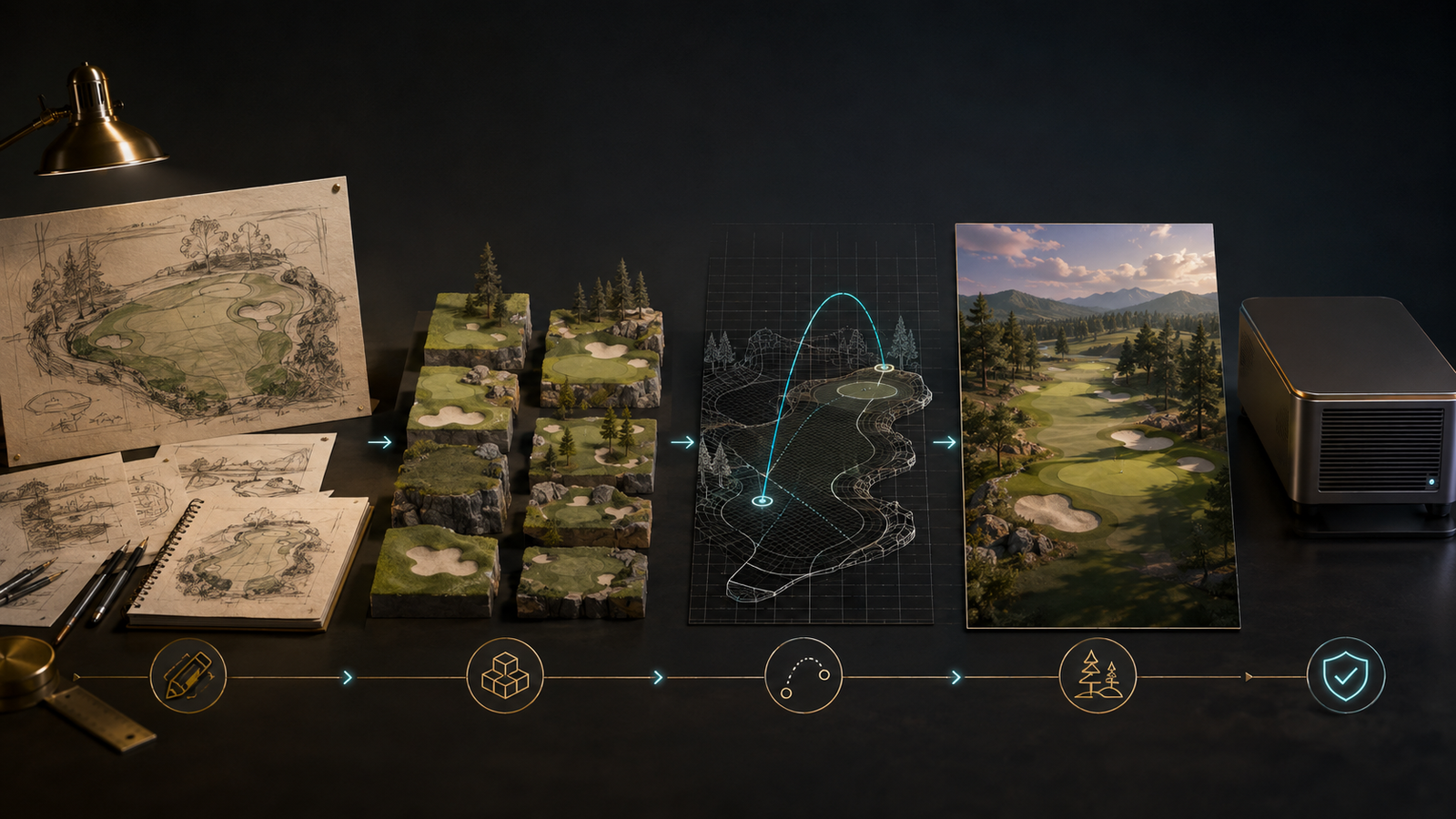
A small video game can become visually impressive long before it becomes buildable.
Concept art arrives first. Then a terrain experiment, a character test, a physics script, a promising render, and a folder full of exports. Each artifact looks like progress. Together they can still describe five different games.
The useful first build was not a level. It was a pipeline that made every artifact answer the same questions: What is this? Where did it come from? What can it prove? What is allowed to happen next?
Concepts are authority, not geometry
An environment painting can establish mood, composition, regional character, landmark hierarchy, and the feeling of a shot. It cannot silently become surveyed terrain.
The production path therefore separates visual authority from spatial authority. Concept boards govern the look. Structured hole briefs govern routing and strategy. The engine governs measured terrain, collision, cameras, lighting, and play. Individual assets—rocks, trees, signs, buildings—can move through their own modeling path without pretending to solve the whole scene.
This sounds slower than importing a beautiful image and asking a generator to make it three-dimensional. It is faster than rebuilding a course after discovering that the camera, hazards, and playable surface never agreed.
The first gate is cheap
Every expensive stage should be preceded by a cheap test that can disqualify it.
A source file should pass naming and provenance checks before conversion. A model should survive a thumbnail review before retopology. A golf shot should pass deterministic trajectory checks before anyone tunes particles or sound. A native build should launch before a trailer calls the project playable.
The point is not bureaucracy. The point is to spend fidelity only after the lower-cost evidence holds.
That rule also changes how AI is used. A model can draft briefs, inspect consistency, propose bounded asset lists, and help write deterministic checks. It should not be allowed to convert a plausible screenshot into a completion claim. The stronger the generator, the more important the gate becomes, because convincing output makes missing evidence harder to notice.
Storage is part of the design
Game projects produce heavy, disposable material: caches, temporary renders, generated meshes, texture variants, build artifacts. Mixing those with source authority turns backup into archaeology.
The pipeline keeps source, generated intermediates, verified exports, and disposable caches in separate lanes. Heavy work can live on external storage while the tools that need dependable local installation remain local. If the external volume is absent, the run stops instead of quietly filling an internal disk or writing to the wrong path.
That is not glamorous game design. It is what makes iteration repeatable.
A screenshot is not a build
The final distinction is the most useful one: authored, generated, compiled, launched, and played are different states.
A scene file can exist without compiling. A project can compile without launching. A build can launch without completing the shot loop. A visually complete hole can still fail collision, camera, or input checks.
The project becomes legible when those states remain separate. Then a concept can be celebrated as a concept, an experiment can remain cheap, and a verified build can mean something specific.
The first playable level will matter. The pipeline matters first because it is the part that makes the second level cheaper than the first.