The Second Brain needed a job description.
A beautiful knowledge graph becomes another inbox unless it is clear what belongs there, what stays elsewhere, and which system is allowed to call work complete.
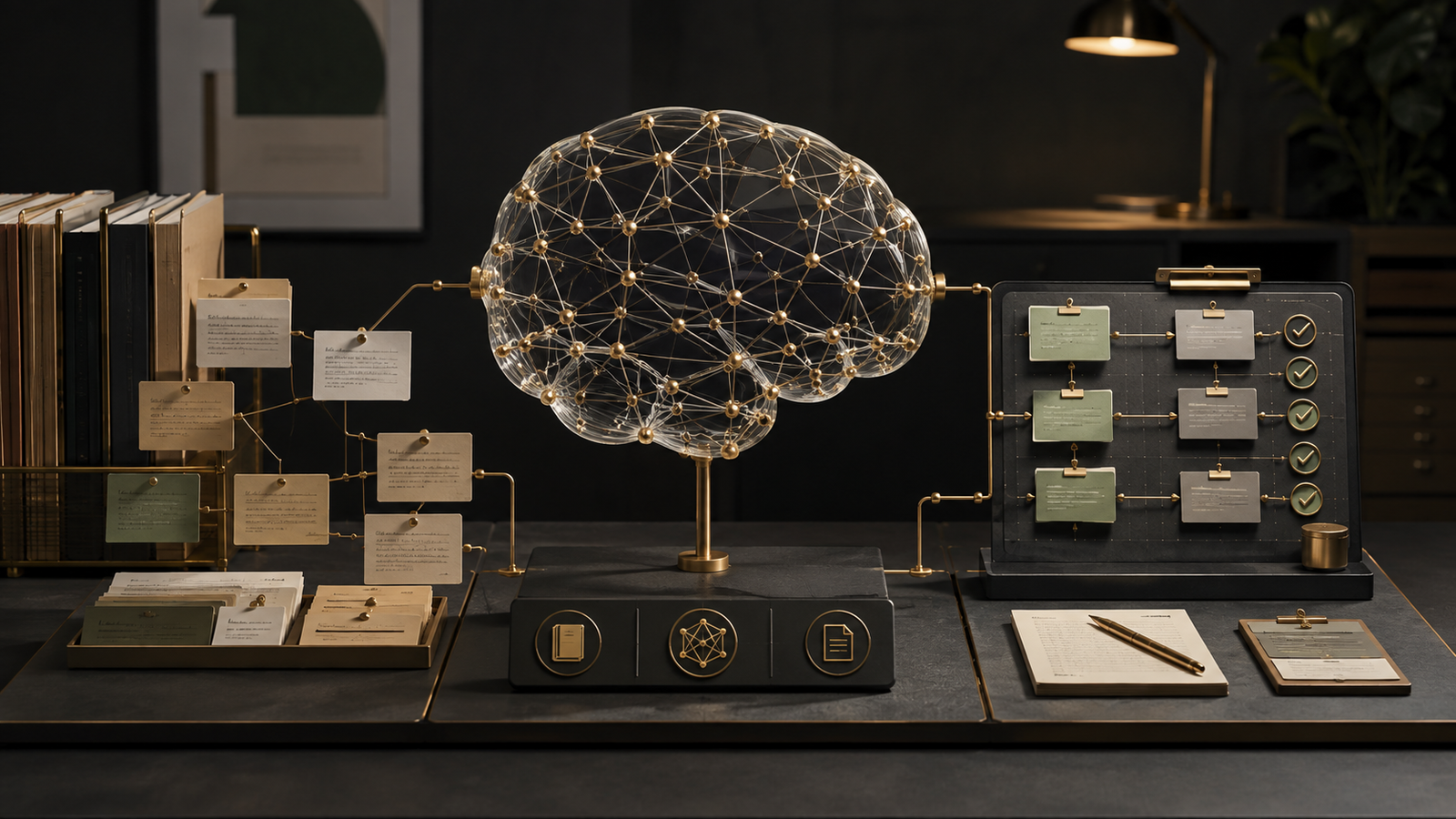
A Second Brain can absorb almost anything. That is its most attractive feature and its first design problem.
Notes, files, tasks, financial records, research, meeting decisions, agent outputs, and dashboards can all be connected. Once everything is connected, the graph looks intelligent. The operating question remains unanswered: which system owns the truth?
The architecture became useful only after the Second Brain received a narrow job description.
Durable context belongs in the brain
The Second Brain owns knowledge that should remain understandable after the current task disappears: decisions, research summaries, project maps, canonical facts, postmortems, source links, and the reasoning behind constraints.
Its unit of value is not the document. It is the durable relationship. A decision links to its evidence. A project links to the constraints that shape it. A postmortem links to the rule that changed afterward.
This is the material an AI assistant needs when a fresh conversation begins. It should be compact enough to retrieve, grounded enough to trust, and stable enough to survive a tool change.
Active work belongs in a task system
Tasks behave differently. They have owners, deadlines, dependencies, checklists, outputs, and completion evidence. They change quickly. Their value is operational pressure, not long-term explanation.
Putting tasks directly into a knowledge graph blurs “we know this” with “someone must do this.” Putting all knowledge into a task board creates the opposite problem: context is scattered across closed cards and decays when the board is cleaned.
The better boundary is explicit. The task system owns actionable work and execution history. The Second Brain owns durable context. A task can link to a note; a note can explain why the task exists. Neither needs to impersonate the other.
Source systems keep their authority
Connection does not require consolidation.
Accounting records should remain authoritative in the accounting system. Operational registers should remain authoritative in their structured database. Original files should remain in their governed storage. The Second Brain can index, summarize, and connect those sources, but it should carry freshness and provenance rather than silently copying itself into authority.
That boundary protects both humans and agents. A summary can be useful without becoming a ledger. A snapshot can support a decision without pretending to be live.
AI needs read paths before write paths
The safest useful assistant begins with retrieval. It can search across notes, surface connected decisions, compare a task with its source evidence, and explain where a fact came from.
Write access should arrive later and in smaller pieces. Creating a draft task is different from completing one. Updating a note is different from changing a financial record. Completion should require evidence that the destination accepted the result, not merely that an AI produced an answer.
The Second Brain became more valuable when it stopped trying to be the whole operating system. Its job is to preserve context, make relationships visible, and give each action a trail back to its source.
A brain does not need to own every movement. It needs to remember why the movement mattered.