I run three ventures from one Obsidian vault. Here's the 13-folder template.
Why a markdown vault outperforms a Notion plus Asana plus Drive plus Slack stack when AI agents are part of the work. Battle-tested across QC, MHG, and Parley.
In late March I killed a custom Electron app I had been building called TruPath OS. It was supposed to be the operating system for my holding company. Typed schemas, custom UI, a 20-agent build team scoped to ship it. I wrote about that postmortem in Issue 0001.
The replacement was an Obsidian vault. Just markdown files in numbered folders, opened in Obsidian, edited by me, and read by Claude Code. Six weeks in, it runs every operational and strategic concern across Quantum Caddy, Mile High Golf, and Parley. I'm shipping the template publicly.
Why the SaaS stack fails with agents
The reasonable default for most operators is a stack. Notion for docs. Asana or Linear for tasks. Drive for files. Slack for chat. Calendar, Email, GitHub, Figma. For a thirty-person company with funded operations this is fine. For a solo operator running multiple ventures with AI agents in the loop, it isn't.
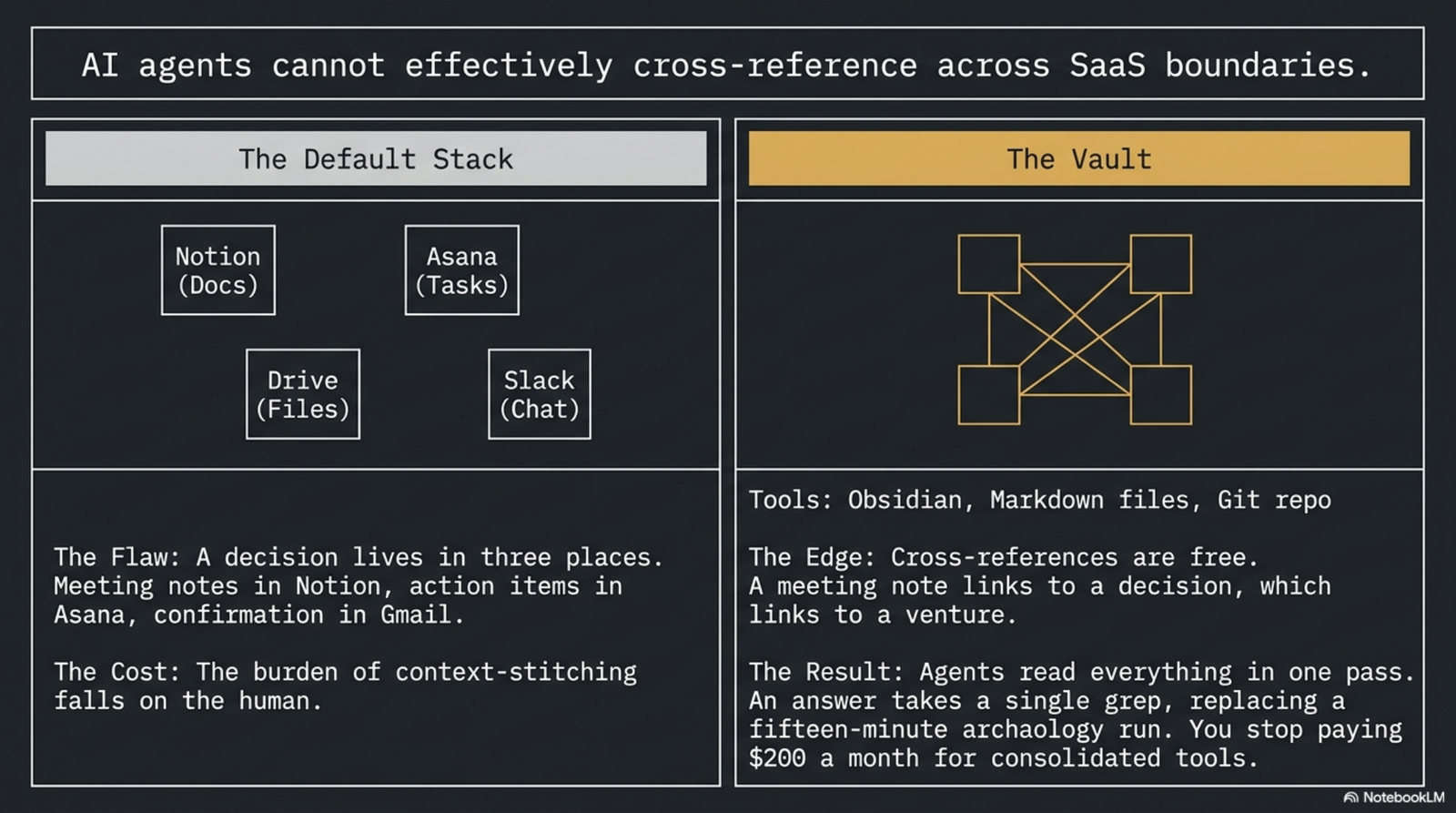
The reason isn't that any individual tool is bad. The reason is that AI agents cannot effectively read across SaaS boundaries. Your agent can search Notion, query Asana, browse Drive, summarize Gmail. It can't easily cross-reference them. The decision we made in Tuesday's meeting lives in three places. The meeting notes in Notion, the action item in Asana, the email confirming it in Gmail. Each is partially correct. None of them is queryable as a whole. The cost of context-stitching falls on you. This is a small problem when you have a team holding the cross-references in their heads. It's a large problem when you're solo and the agent is supposed to be the team.
Move everything into one vault
Move everything you reasonably can into a single Obsidian vault. Markdown files, structured frontmatter, in one git repo. Several things change at once. Cross-references become free. A meeting note links to a decision, which links to a person, which links to a venture. Obsidian's graph view shows you the actual structure of your work. Agents read everything in one pass. What did Sarah say about the lease last month is a single grep across three files, the same answer you'd get from a fifteen-minute archaeology run. Versioning is git, not vendor history; you own your data. Your agent's context window holds your work, not tooling chrome. Markdown is the most token-efficient format an agent will ever read. And you stop paying $200 a month for tools you've consolidated.
The 13-folder structure
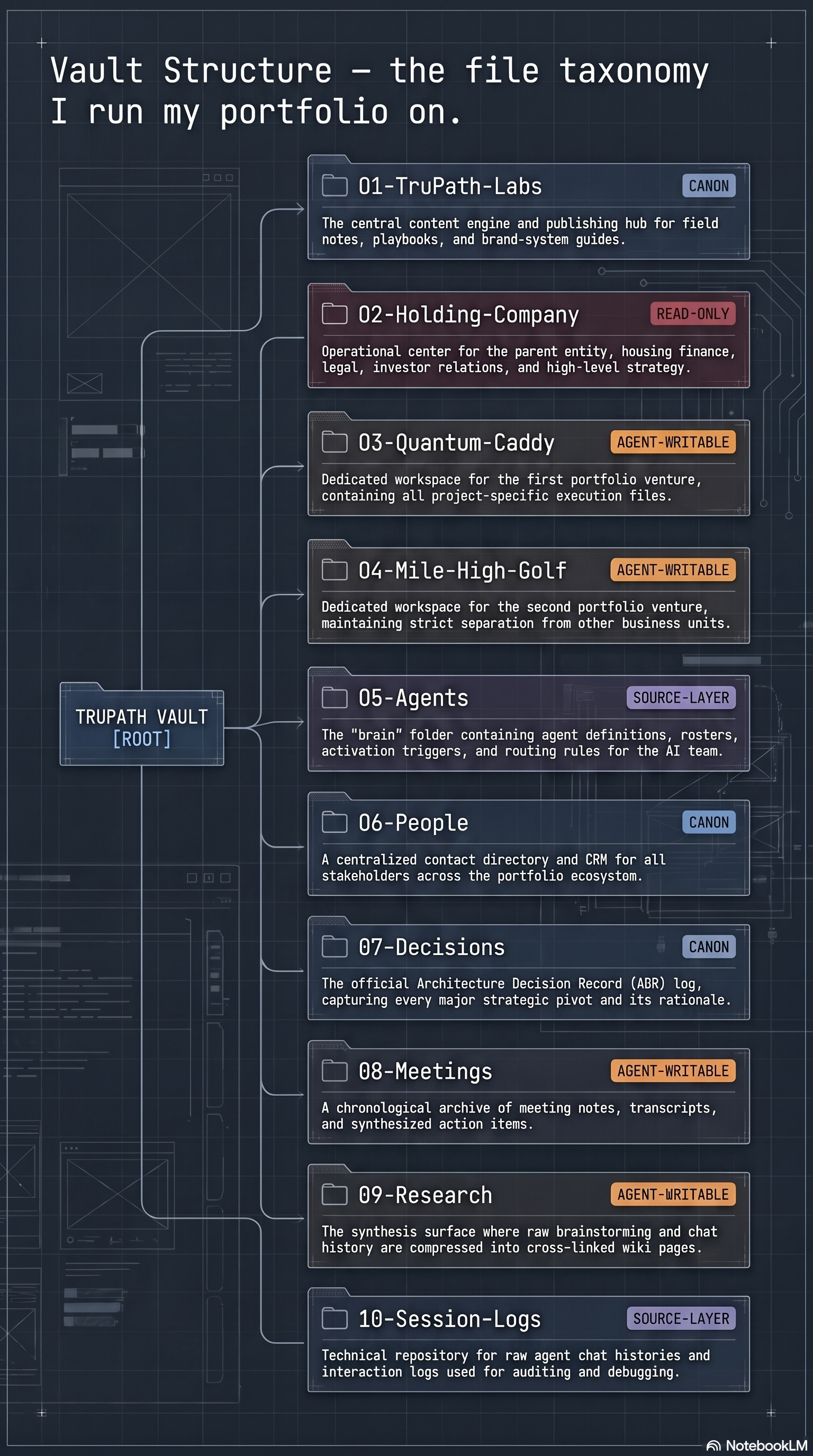
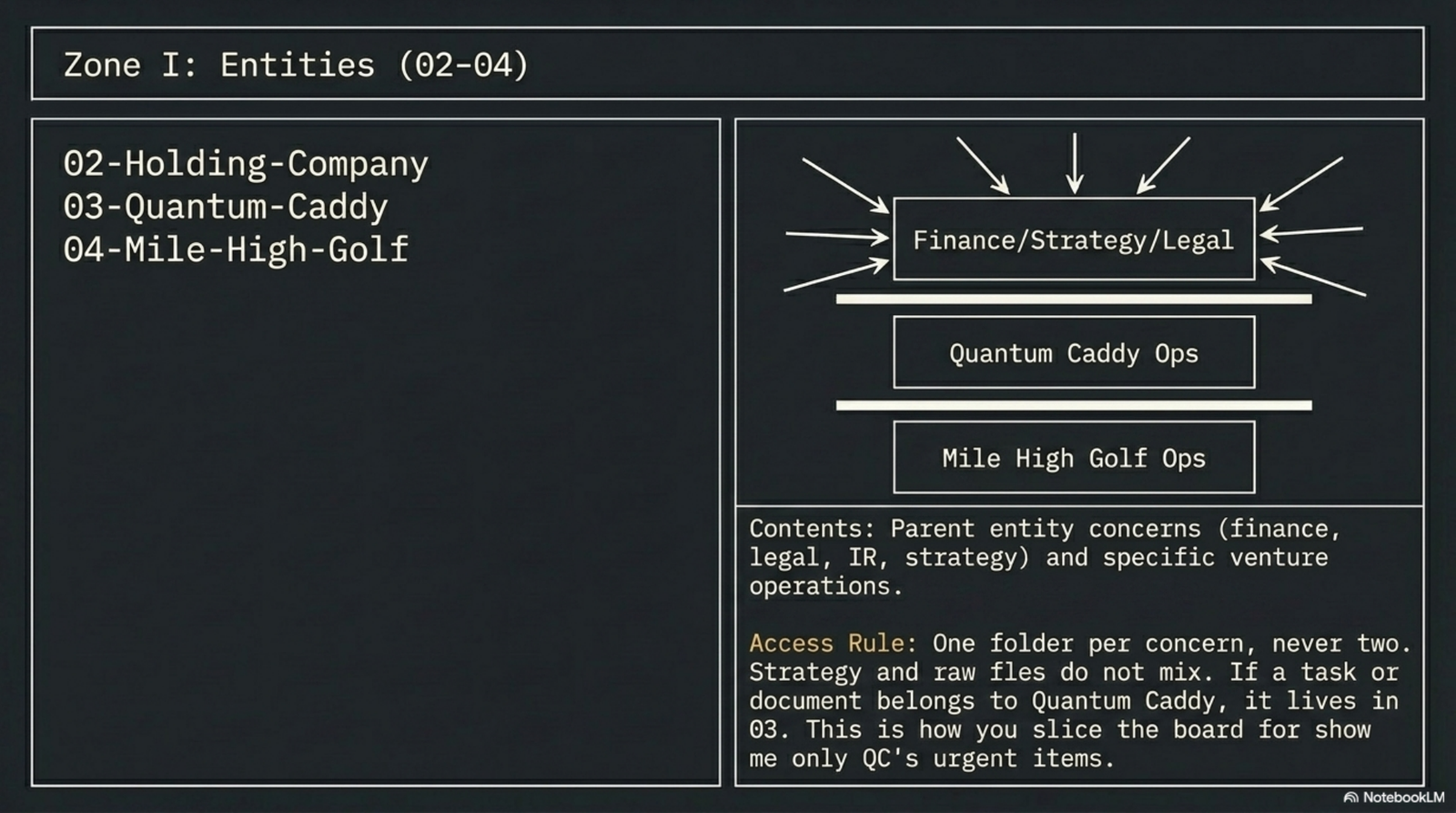
The vault has thirteen folders. 00-Inbox for raw captures, processed weekly. 01-Labs for the content engine. 02-Holding-Company for the parent entity (finance, legal, IR, strategy). 03 and 04 for the first two ventures. 05-Agents for agent definitions, rosters, and activation guides. 06-People is the contact directory. 07-Decisions is the ADR log. 08-Meetings, 09-Research, 10-Session-Logs, 11-Archive, 12-Templates, 13-Social-Media. The numbering is deliberate. Without numbers, Strategy and Stuff sit next to each other and your eye has to do work to find what you want. With numbers, the order is your operational priority and the eye relaxes. One folder per concern, never two. Decisions live in 07-Decisions. Always. Not sometimes in the venture folder. Once your agent learns this convention it routes correctly forever.
The synthesis layer in 09-Research
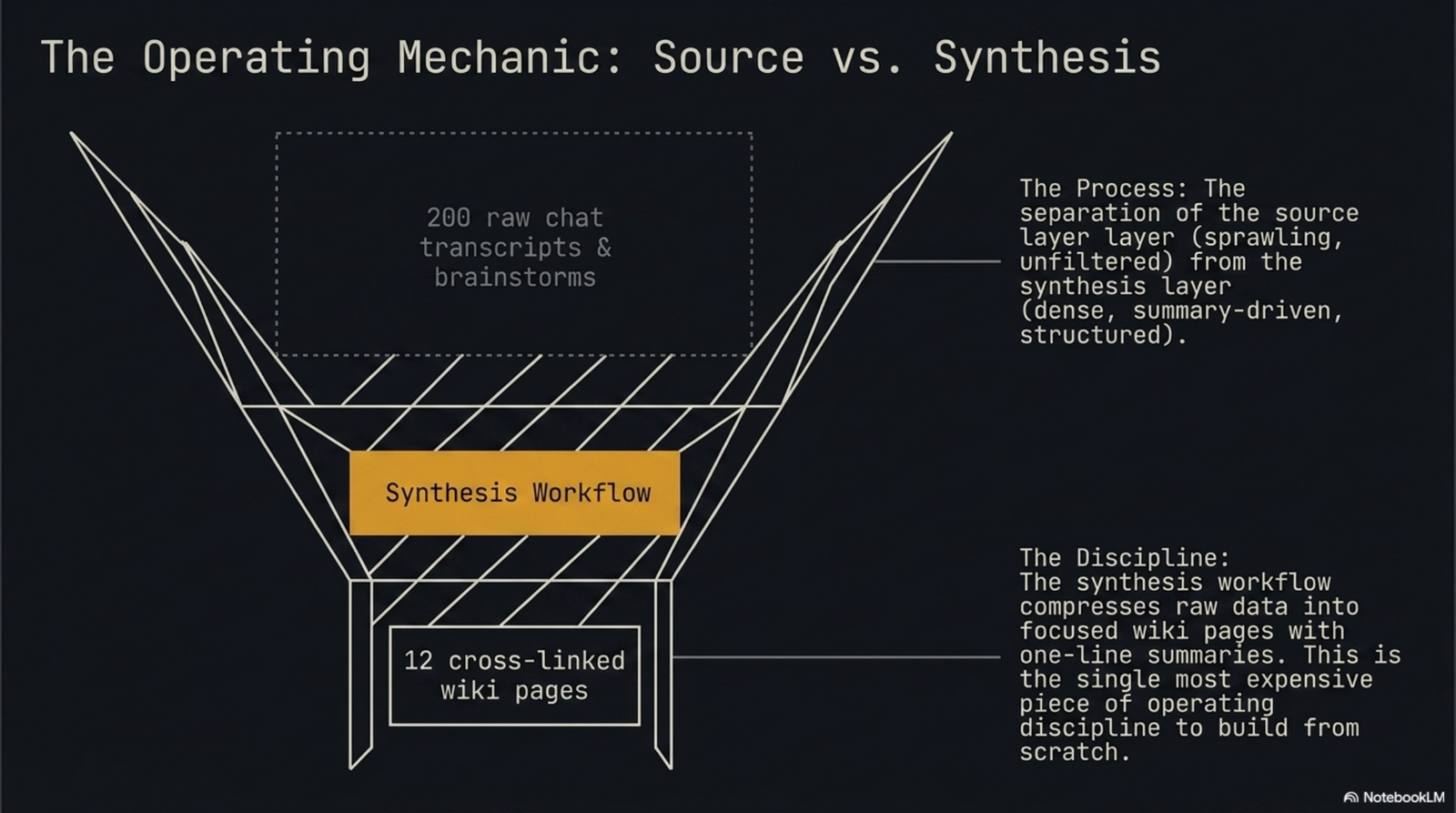
Inside 09-Research is the synthesis surface. Raw chat history, raw research, raw brainstorming all flow into 09-Research/Inbox. The synthesis workflow compresses them into focused, cross-linked wiki pages with one-line summaries. For QC, this means the work I did on cornhole physics, sensor selection, ACL competition rules, and venue installation requirements lives in twelve wiki pages with bidirectional links instead of two hundred chat transcripts. When I ask Claude a question about the QC sensor strategy pivot, it reads three wiki pages, not three months of conversation history. This is the single most expensive piece of operating discipline to build from scratch. The bundle ships with the workflow, the page format, the index pattern, and a worked example.
A five-agent placeholder
The vault includes a five-agent placeholder model. A Chief of Staff, two Venture Directors, an Engineering specialist, and a Legal/IP specialist. The names are placeholders; replace with the agents your portfolio actually needs. The pattern worth keeping is the number. After eight months of running an AI-augmented operation, my honest take is that a small set of named, scoped specialists is more reliable than a sprawling cast of agents that don't know their lane. I started with fourteen agents. I cut to five. The work got better. The bundle includes the roster pattern, the activation triggers, the routing rules, and one fully-written example agent.
For cross-venture task tracking, the bundle documents a Supabase-backed schema. A tasks table with id, venture, column (urgent, active, waiting, someday, done), title, notes, sub_items as JSON, a done flag, sort_order, and updated_at. With Row-Level Security and a publishable key, your agent can read and write tasks via REST. The sub_items JSON gives you checklist sub-tasks under each parent. The venture tag is required, since it's how you slice the board for show me only QC's urgent items. Build a dashboard HTML on top of this, or use the Obsidian Kanban plugin instead. Same fields, simpler integration, no Supabase.
Costs and tradeoffs
This structure has costs. Discoverability is worse for new users. A new contributor, human or agent, can't browse Notion and see what's there. They have to learn the folder convention. The first day in a new vault is harder than the first day in a familiar SaaS product. Real-time collaboration is harder; Obsidian Sync helps, but live multi-user editing isn't its strength. Vendor-managed reliability is gone. Your data is on your machine and your git remote. If both die you have a problem. Backup discipline matters. For most readers, solo operators or two-to-three-person teams using AI agents, these tradeoffs are worth it. By the time you have a team that needs Google-Docs-style real-time editing, you've outgrown this specific structure anyway.
Three adoption phases
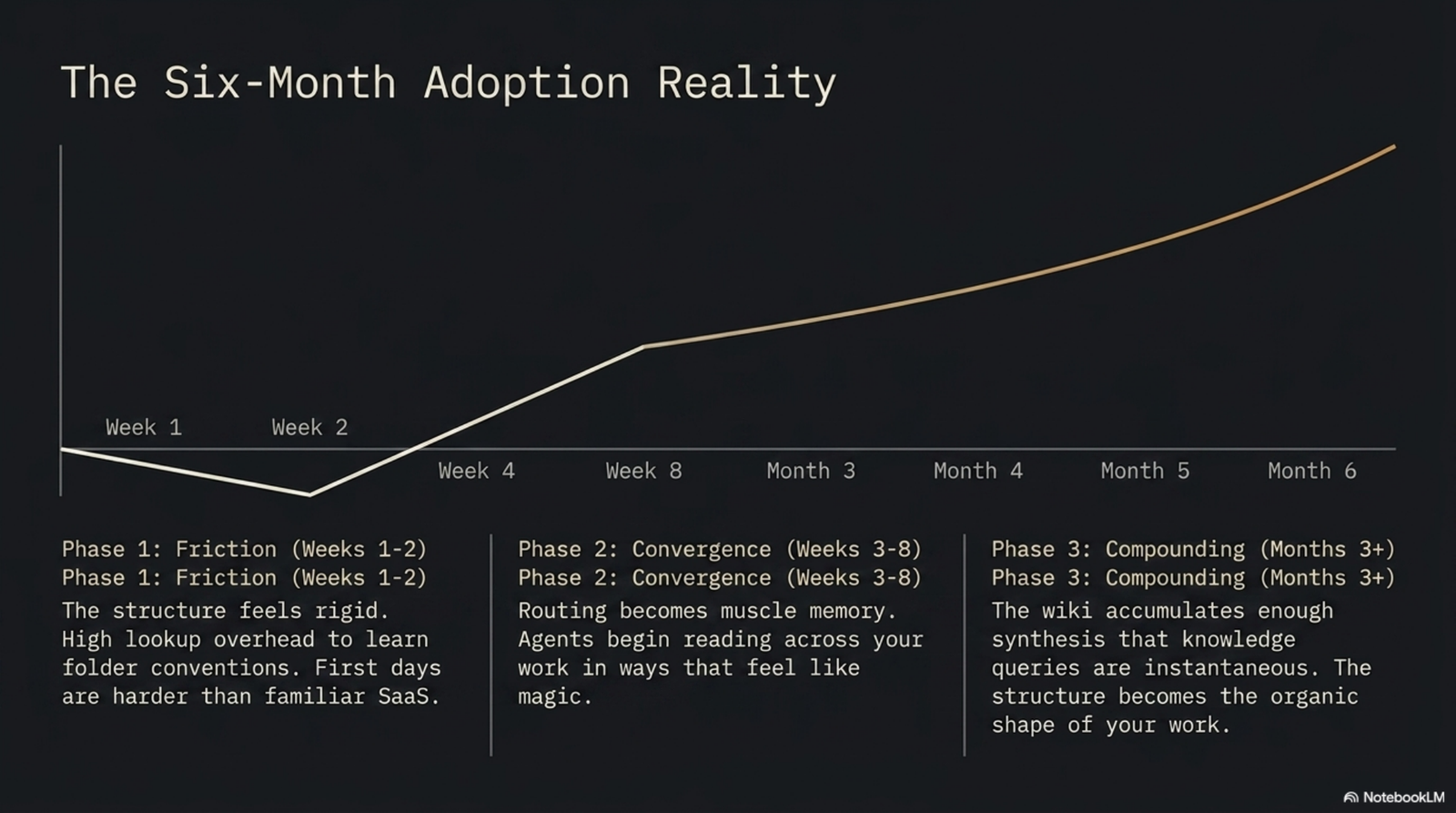
Three phases for most adopters. Weeks one and two are friction. The structure feels rigid. You're constantly looking up which folder is for what. Weeks three through eight are convergence. You stop thinking about where things go. Agents start reading across your work in ways that feel like magic the first time. Months three and beyond are compounding. The wiki has accumulated enough synthesis that knowledge questions are fast. New patterns absorb without much disruption. After about six months the structure feels less like a tool and more like a shape your work organically takes.
Get the template
The repo at github.com/420Hippie/vault-structure has a working template vault (thirteen folders, all thirteen templates, an example wiki page, an example agent file, a CLAUDE.md template), a getting-started guide that walks through the first thirty minutes, the framing essay, and an MIT license. Clone it. Open it in Obsidian. Customize CLAUDE.md to match your portfolio. The first month will feel like overhead. By month three it'll feel like the only sane way to run your work.