From Pixels to Club Physics: An Evidence-Bounded Architecture for Monocular Golf-Club Pose, Kinematics, and Training Data
Abstract
Markerless golf-swing systems often move too quickly from visible pixels to physical claims. This technical review combines an audit of public GitHub and Roboflow resources, recent golf-club pose research, and a project-specific five-landmark evidence contract to define what a monocular Swing Trainer can and cannot infer. We classify available sources by semantic compatibility, rights, and evaluation value; derive the propagation from image-coordinate error to velocity uncertainty; and propose a staged architecture separating observation, interpolation, calibration, kinematics, and coaching. The review finds that public data can support detector warm starts, but no verified openly downloadable commercial corpus found in our audit supplies hundreds of examples in the exact target schema. Further, uncalibrated single-view tracks directly support image-plane motion—not physical clubhead speed, face angle, or three-dimensional swing plane. We provide a reproducibility and validation protocol designed to keep missing evidence missing and to prevent visually convincing overlays from outrunning their measurement basis.
1. Introduction
Golf-club motion is both visually salient and unusually difficult to measure. The shaft is thin, the head changes appearance with orientation, and the fastest portion of the downswing concentrates blur, occlusion, and large inter-frame displacement into the moment users care about most. Recent systems such as CADDIE explicitly identify thin geometry, motion blur, and self-occlusion as central club-pose problems [1]. GolfPose likewise shows that adding club landmarks changes the golf-pose problem rather than merely extending a human skeleton [2].
The product temptation is to treat a recovered screen-space trajectory as physics. A rendered arc appears metric even when its coordinates are only pixels. This paper takes the opposite posture: define the observation contract first, attach every stronger inference to a validation requirement, and preserve missing evidence rather than replacing it with a visually satisfying estimate.
This is a technical review and architecture paper, not a model-results paper. No trained Swing Trainer club model, real five-point golden set, physical-device accuracy result, or validated clubhead-speed result is reported. Public-source counts are pinned to the versions audited on 16 August 2026 and can change.
2. Research Questions
We ask four bounded questions: (1) Which public or author-accessible sources can support a commercial five-landmark golf-club model? (2) Which landmark semantics preserve useful club geometry without claiming unobserved variables? (3) What quantities follow directly from monocular image tracks, and where do calibration and external instruments become necessary? (4) What evaluation design prevents video leakage and missing-evidence bias?
3. Methods
3.1 Source discovery and qualification
Discovery covered official GitHub repositories, paper pages, Roboflow Universe project versions, Kaggle, Hugging Face, and locally staged artifacts. A source was not classified by topical relevance alone. Qualification recorded exact version, media and annotation provenance, license or access condition, landmark semantics, source grouping, checksum, and permitted role: detector warm start, relabeling candidate, research-only input, quarantined material, or possible final-schema truth.
The audit applied a strict semantic rule: a dataset with five numbered points is not compatible unless the five anatomical or equipment landmarks are defined. A point cannot be renamed merely because it occupies a similar region. This rule is especially important across CADDIE, GolfPose, and Roboflow, whose club schemas were created for different objectives.
3.2 Evidence contract
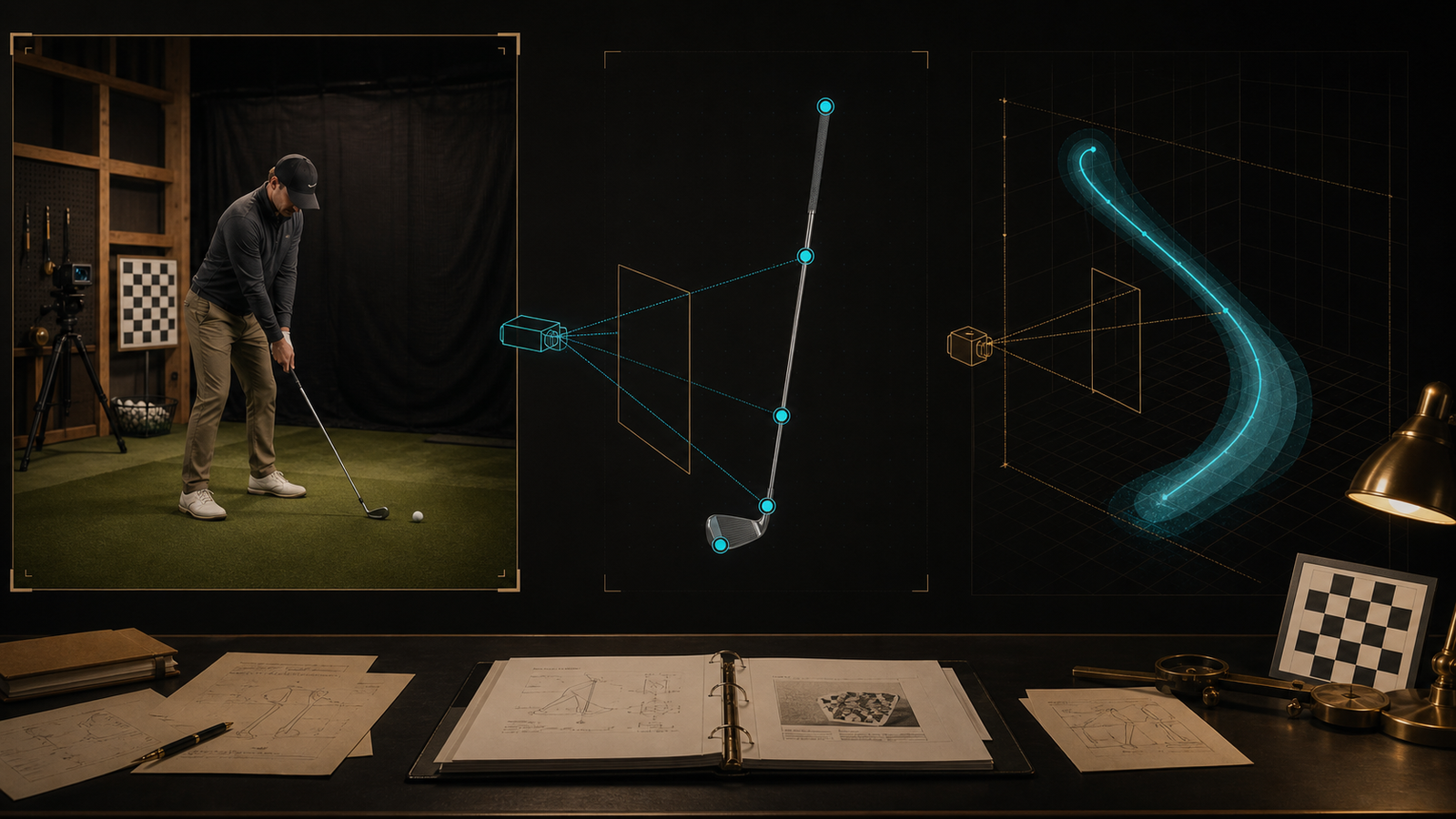
The target five-point-club.v1 contract contains grip, shaft-grip junction, hosel, inner clubhead, and outer clubhead. Each landmark carries one of five states: observed, occluded, outside-frame, not-present, or not-annotatable. Coordinates exist only for observed evidence and use normalized image coordinates with a top-left origin. Predicted, filtered, or interpolated positions are prohibited from the golden labels.
3.3 Kinematic derivation
Let an observed landmark at frame i be pi = (ui, vi) in pixels and let its measured timestamp be ti. The directly observed displacement is Δpi = pi+1 − pi; the image-plane velocity estimate is Δpi / Δti. It has units of pixels per second, not metres per second.
If the standard deviation of independent localization error is σp per coordinate, first-difference velocity uncertainty scales approximately as √2σp/Δt. Differentiation therefore amplifies localization noise, while smaller frame intervals increase sensitivity to timestamp and position error. Acceleration introduces another difference and is more fragile still. Filtering can reduce variance but introduces assumptions, lag, and potential peak suppression; the observed and filtered series must remain distinguishable.
A physical speed estimate requires a mapping from image motion to spatial motion. Under a calibrated planar assumption this can be represented by a homography, but a golf club does not remain on a single known image-parallel plane. General three-dimensional recovery requires additional constraints, multiview geometry, stereo, an instrumented reference, or an independently validated learned reconstruction. A body or club prior can regularize an estimate; it does not make depth directly observed.
4. Results
4.1 Dataset fitness
| Source | Scale | Club labels | Rights/access | Defensible role | |
|---|---|---|---|---|---|
| CADDIE GolfClub | 72,000 frames | 5: grip, shaft, neck, head-in, head-out | No public data license/download verified | Best semantic candidate; author request required | |
| GolfPose | 17,738 frames / 6 subjects | 5: shaft, hosel, heel, toe-down, toe-up | Authorization + custom EULA | Alternate head or transfer research; not direct mapping | |
| Roboflow SwingFeed v3 | 7,842 images | Detection classes | CC BY 4.0 version audited | Detector warm start and hard-negative mining | |
| Roboflow Golf-keypoint v2 | 233 images | 14 keypoints | CC BY 4.0 version audited | Relabeling or exploratory pose work | |
| Roboflow Club Keypoints v6 | 220 images | 3 club keypoints | CC BY 4.0 version audited | Relabeling base; not five-point truth | |
| CaddieSet | 1,757 shots / 8 golfers | Body features + ball/shot metadata | MIT repository | View metadata and calibration research |
Compatibility requires landmark meaning, provenance, and license—not merely a matching keypoint count.
CADDIE is the closest semantic candidate: its paper describes 72,000 annotated frames, seven subjects, six locations, three club types, synchronized multiview sequences, and five shaft/head landmarks [1]. The audited paper and repository searches did not yield a public dataset download with commercial reuse terms; it therefore remains an author-access candidate, not acquired production data.
GolfPose provides an official implementation, reported train/test separation by golfer, and a custom EULA that allows commercial model training after authorization while restricting raw-data redistribution [2]. Its five club landmarks—shaft, hosel, heel, toe-down, and toe-up—do not directly equal the target contract. Its strongest defensible roles are alternate-head research, representation transfer, or manually governed conversion where the source pixels support new annotations.
The audited Roboflow exports are useful but stage-specific. SwingFeed’s 7,842 images support detector pretraining and hard-negative mining [9]. The 233-image fourteen-point and 220-image three-point exports can seed relabeling or exploratory pose work [8] [7]. None is final five-point truth as downloaded.
4.2 From observation to claim
| Layer | Directly supported output | Additional requirement | Blocked overclaim | |
|---|---|---|---|---|
| Observation | 2D landmark coordinates + visibility state | Human-reviewed golden labels | A missing or blurred point has a true coordinate | |
| Temporal | Image-plane displacement and event timing | Measured timestamps; declared filtering | A smooth curve is ground truth | |
| Calibrated 2D | Plane-referenced distance/speed | Intrinsics, scale, fixed geometry, planar assumption | One ground scale calibrates arbitrary depth motion | |
| 3D kinematics | Physical trajectory and velocity | Multiview/stereo or independently validated reconstruction | Single-view pixels uniquely determine 3D path | |
| Club delivery | Face angle, path, attack, impact variables | Instrumented reference and error study | Five landmarks automatically equal launch-monitor output | |
| Coaching | Scoped evidence cards or validated feedback | Outcome-linked study and policy gates | Pose similarity proves a universal swing fault |
Each layer inherits uncertainty from the layers beneath it.
Single-video golf research demonstrates that useful proficiency and repeatability signals can be extracted from two-dimensional pose and clubhead tracks [4]. That result supports careful image-plane analysis; it does not erase projective ambiguity. Laboratory clubhead-speed studies typically use multi-camera motion analysis, launch monitors, or instrumented clubs [5] [6], illustrating the additional measurement basis behind physical quantities.
4.3 Architecture implication
The defensible pipeline is staged: detect golfer and club; estimate five visible landmarks; emit visibility and uncertainty; preserve raw timestamped observations; optionally create a separately labeled filtered track; calibrate only within a declared geometry; validate physical variables against an external reference; then expose only claims that passed their layer-specific gate. Coaching must consume evidence with its provenance and blocked fields intact.
5. Evaluation and Reproducibility Protocol
Every original clip receives a source-group identifier. All derivatives—frames, crops, transcodes, and augmented versions—remain in the same split. Every clip from one golfer remains in one split. The manifest is frozen and hashed before training. This blocks the common error of placing near-identical neighboring frames or the same golfer’s appearance in both training and test.
Evaluation must report paired pixel and normalized errors per landmark; ground-truth visibility counts; missing predictions; unexpected predictions where truth is unobserved; and outlier examples. Results are stratified at minimum by face-on versus down-the-line view, and should additionally cover club type, lighting, blur, occlusion, and framing. A mean error without missing detections is insufficient.
No PCK radius or pass threshold is proposed here. CADDIE reports PCK@5px in its own captured conditions [1]; importing five pixels as a universal product threshold would ignore resolution, crop scale, camera distance, and downstream use. The application threshold must be justified by the physical or interaction error it permits in the target capture setup.
6. Discussion
The central finding is architectural rather than algorithmic: measurement claims should be typed. A system that stores observed, filtered, calibrated, reconstructed, and coached outputs in one undifferentiated trajectory invites evidence laundering. Separating those layers lets the product remain useful early. Users can review a visible path and timing pattern while the engineering team continues validation for physical metrics.
The data result is similarly non-binary. Public resources are not useless because they fail the final schema. They become valuable when assigned a bounded role. Detector images teach scene context. Alternate landmark sets teach representation. Owned footage supplies target-camera truth and clean rights. Author-access datasets can expand diversity when terms and semantics are documented. The dangerous move is merging those roles into one folder and treating file count as evidence quality.
The physics result is a limit, not a defeat. Image-plane paths can support repeatability, timing, view-specific comparisons, and falsifiable tests. Calibration may unlock plane-referenced quantities in controlled setups. Three-dimensional club delivery and impact variables require additional observation or external validation. The boundary tells the product what to build next.
7. Limitations
This review did not obtain or inspect the raw CADDIE GolfClub dataset. Roboflow counts and license labels are version-specific and do not independently establish underlying-media ownership. No annotation agreement study was run. No model was trained. No phone capture was compared with optical motion capture, radar, stereo high-speed video, or a launch monitor. The uncertainty derivation describes generic first-difference behavior and is not a measured error budget for Swing Trainer hardware.
8. Conclusion
A credible monocular Swing Trainer begins by refusing to confuse visibility with physics. The available GitHub and Roboflow work provides useful foundations, but it does not remove the need for target-schema labels, source-disjoint evaluation, calibrated geometry, and external physical validation. Five club landmarks are best understood as an auditable observation interface: enough structure to study motion, enough missing-state discipline to preserve uncertainty, and no automatic license to claim clubhead speed or three-dimensional delivery.
References
- Jung, C., Yang, F., Blanchard, N., & Wong, H. (2026). CADDIE: Compact Adaptive Detection-Driven Inference for Real-Time Golf Club Pose Estimation. CVPR Workshops, 9978–9987. https://openaccess.thecvf.com/content/CVPR2026W/CVsports/html/Jung_CADDIE_Compact_Adaptive_Detection-Driven_Inference_for_Real-Time_Golf_Club_Pose_CVPRW_2026_paper.html
- Lee, M.-H., Zhang, Y.-C., Wu, K.-R., & Tseng, Y.-C. (2025). GolfPose: From Regular Posture to Golf Swing Posture. International Conference on Pattern Recognition, 387–402. Official implementation: https://github.com/MingHanLee/GolfPose
- Jung, S., Hong, S., Jeong, J., Jeong, S., Choi, J., Kim, H., & Lee, W. (2025). CaddieSet: A Golf Swing Dataset with Human Joint Features and Ball Information. CVPR Workshops, 5988–5996. https://github.com/damilab/CaddieSet
- Kim, et al. (2023). Extracting proficiency differences and individual characteristics in golfers' swing using single-video markerless motion analysis. Scientific Reports, 13. https://pmc.ncbi.nlm.nih.gov/articles/PMC10684732/
- MacKenzie, S. J., & Sprigings, E. J. (2017). The most important factor in producing clubhead speed in golf. Journal of Biomechanics, 54, 138–143. https://doi.org/10.1016/j.jbiomech.2017.01.007
- Grober, R. D. (2010). An accelerometer based instrumentation of the golf club: measurement and signal analysis. arXiv:1001.0956. https://arxiv.org/abs/1001.0956
- Annotateathon. Golf Club Keypoints, version 6. Roboflow Universe. Audited 2026-08-16. https://universe.roboflow.com/annotateathon/golf-club-keypoints
- Kilkenny Robo. Golf-keypoint, version 2. Roboflow Universe. Audited 2026-08-16. https://universe.roboflow.com/kilkennyrobo/golf-keypoint
- SwingFeed. Golf detector dataset, version 3. Roboflow Universe. Audited 2026-08-16. https://universe.roboflow.com/swingfeed/golf-49wbh-spfor
Evidence status: architecture and source audit; no trained-model or physical-device performance claim.