Do not put the club in the body frame.
A pose system can see a body, a club detector can see a club, and a launch monitor can report a ball. Calling all three one measurement is how a golf product starts inventing facts.
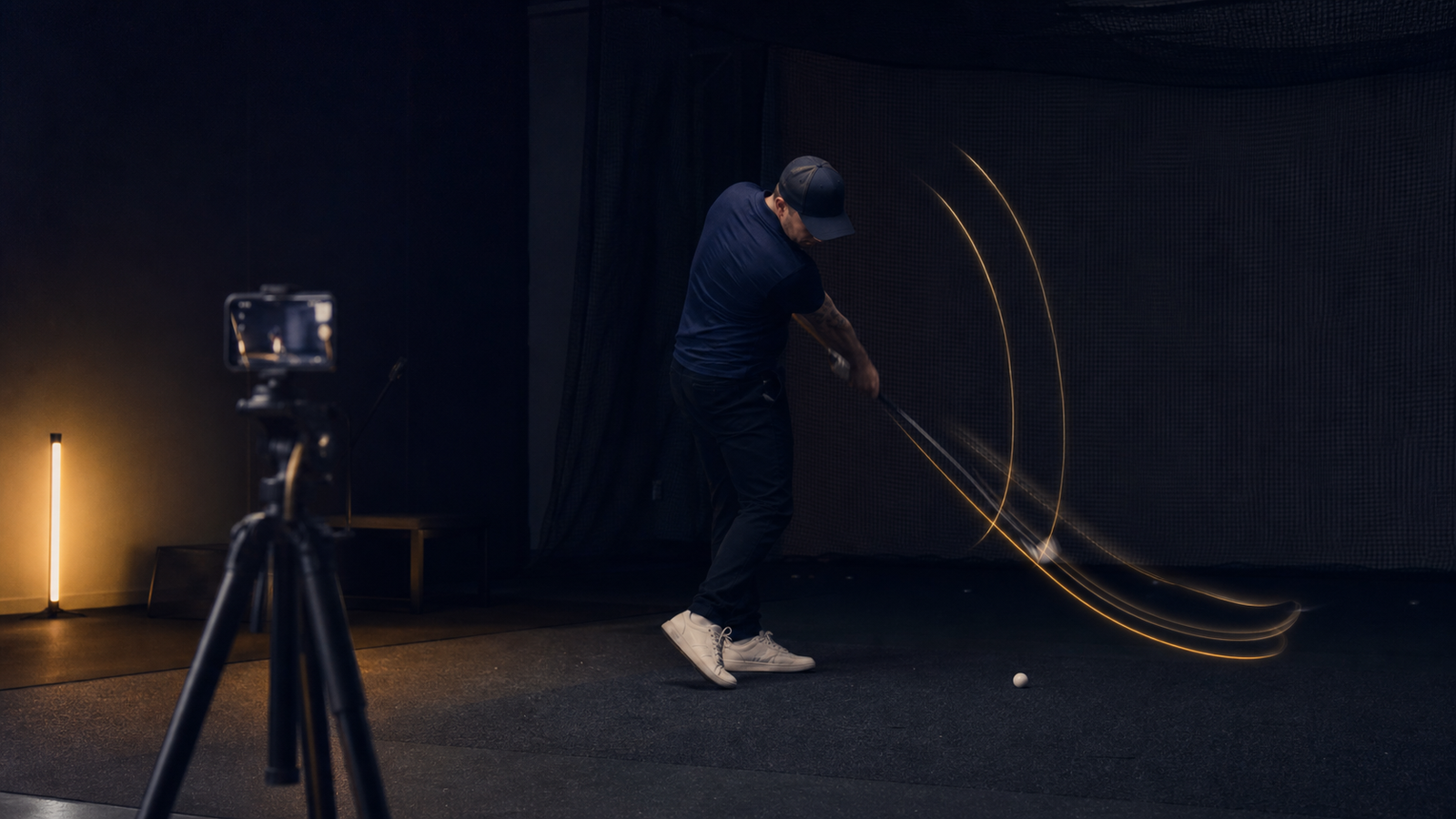
A golf swing is full of things that look easy to combine.
Body landmarks. A club trace. A ball outcome. A clean line drawn through a missing observation. One tidy record to hold it all.
We rejected that design.
Three subjects, three evidence streams
Swing Trainer’s body pose remains a body-only stream. Club and ball evidence are sibling streams, not optional fields tucked into the pose frame.
That sounds like an implementation preference. It is an evidence rule.
Each subject has different detectors, confidence behavior, occlusion problems, model versions, and calibration needs. A club detector can fail while the body remains visible. A ball outcome can come from a launch monitor, a manual entry, or an import. None of those facts should rewrite what the camera directly observed about the golfer’s body.
Missing is a legitimate value
The key rule is that unobserved points stay absent.
The system can retain a point’s source timestamp, source-frame index, normalized coordinates, confidence, camera view, model version, and provenance: observed, filtered, or predicted. It can also keep separate trace segments when there is an observation gap.
It cannot draw a continuous line across a gap and present that as camera evidence.
That rule has consequences. A renderer can show the difference between observed and predicted information. A future metric can refuse to score a motion when the supporting evidence is missing. A customer is less likely to receive a number whose precision came from the interface rather than the camera.
Body pose is not a launch monitor
The same boundary removes a tempting claim from the product. Ordinary two-dimensional body pose cannot honestly produce true axial shoulder-pelvis separation, so the unsupported xFactorDeg field was removed from the body contract.
Likewise, body or club traces are not a legal source for shot outcome. A ball result must be labeled as launch-monitor, manual, or imported.
That makes the system less impressive in a demo. It makes it more useful when the user is deciding whether to trust it.
The point of the architecture
The desired product may eventually combine body, club, ball, video, and calibration evidence into one swing record. The combination is not the same as pretending every stream saw the same thing.
The architecture leaves room for each tracer to improve independently. More importantly, it preserves the right to say “we do not know” when the evidence is absent.
For a coaching product, that is not a limitation to hide. It is the foundation.