A phone can trace the club. That does not mean it measured clubhead speed.
The physics boundary inside Swing Trainer: what monocular video can support, what calibration might unlock, and what still requires an external instrument.
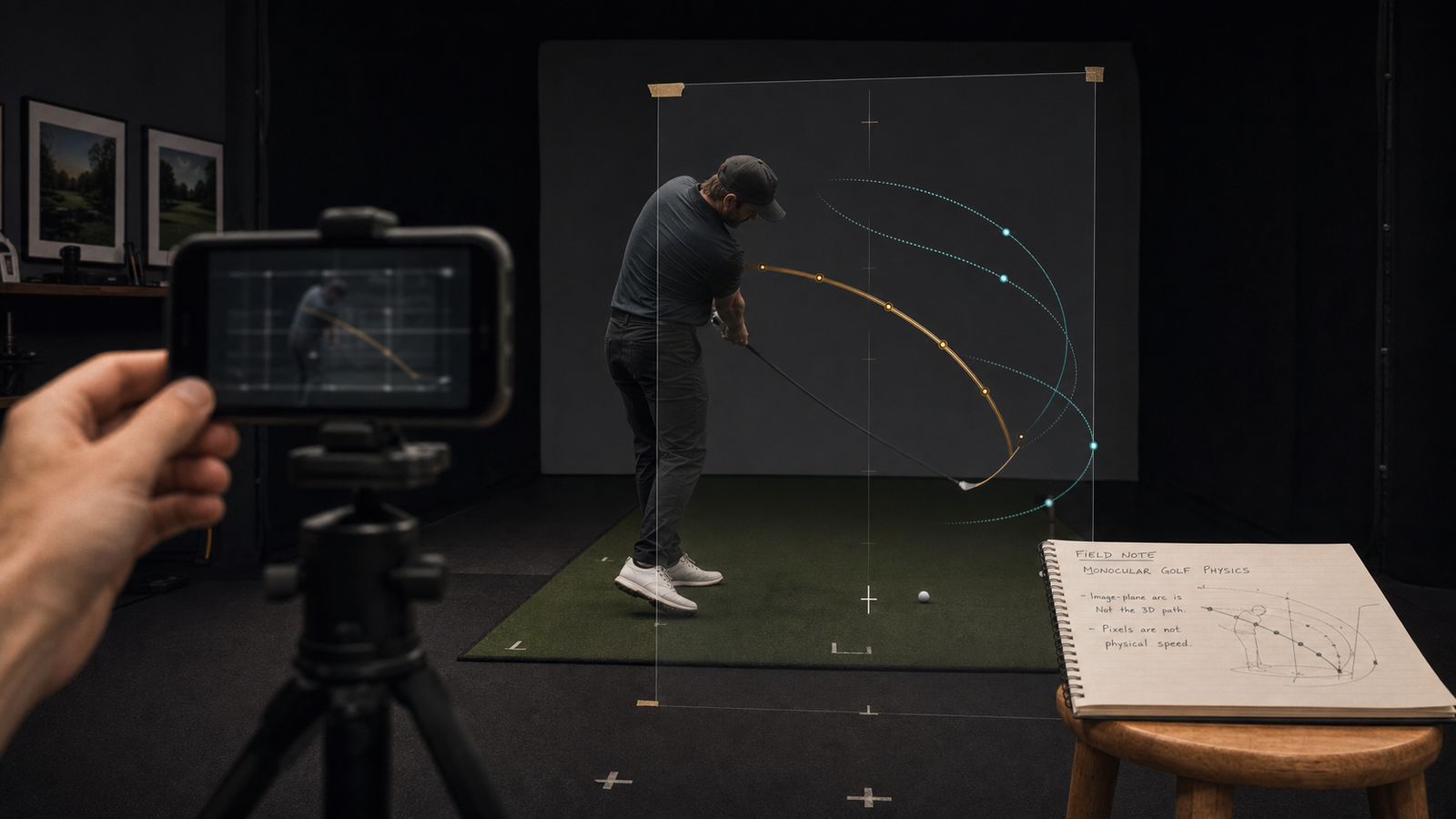
A tracer is persuasive. Put a bright arc behind a golf club and the eye immediately reads measurement, even when the underlying coordinates are only pixels.
That visual confidence is exactly why we wrote the physics boundary before shipping the feature.
The camera sees a projection
A phone records a three-dimensional swing after perspective has collapsed it onto a two-dimensional sensor. Two different physical paths can produce similar image paths. Motion toward the camera can look shorter than motion across the frame. A small camera move changes the apparent plane. Lens distortion bends the edges. Rolling shutter means different rows may not represent exactly the same instant.
If a tracked clubhead moves 80 pixels between two frames, the directly observed quantity is 80 pixels per frame interval. Turning that into miles per hour requires a spatial scale at the club's depth, accurate timing, and a model of how the motion sits relative to the camera. A calibration object on the ground does not automatically calibrate a clubhead moving through depth.
Frame rate is a sampling choice
Near impact the club moves farthest between frames. At 120 frames per second, each frame is separated by about 8.3 milliseconds; at 240 fps, about 4.2 milliseconds. Higher frame rate reduces the time gap, but shutter speed still determines blur, and low light can force exposure choices that erase the head boundary.
The five-point model does not solve that physics. It helps us describe which part of the club was actually seen and how uncertain the image-plane path is.
Differentiation amplifies error
Speed is change in position over time. Acceleration is change in speed over time. Every differentiation step amplifies localization noise. A one- or two-pixel wobble that looks harmless in a path can become a large spike in an instantaneous speed curve, especially when the time interval is small.
Smoothing can make the curve look physical. It can also erase a real transition or invent timing. That is why filtered and predicted coordinates must stay separate from observed golden labels, with the method and window pinned to the result.
What we can ship first
The honest first layer is image-plane evidence: visible club path, swing-event timing, view-specific repeatability, missing-evidence flags, and comparisons made under the same capture setup. Those outputs can help review a swing without pretending the phone is a launch monitor.
The next layer requires calibration and validation. Known camera intrinsics. Fixed placement. A reference scale appropriate to the motion plane. Real frame timestamps. Tests across face-on and down-the-line views. Error reported against an external reference, not against another rendering of the same phone coordinates.
Physical clubhead speed, face angle, and three-dimensional swing plane remain outside the claim until the system earns them against high-speed stereo, optical motion capture, radar, or a validated launch monitor.
The product decision
We could label a pixel-derived curve “speed” and explain the caveat in small text. Many products do. We chose the harder path: name image-plane quantities as image-plane quantities and make stronger metrics pass a validation gate.
That restraint does not make the tracer less useful. It makes the tracer legible. The customer can see what the camera saw, what the model inferred, and what the system still does not know.
The arc is a visualization. The evidence is the product.